

Wondering how to start a digital product business? Starting a digital product business is one of the smartest moves you can make in 2026. You create once, sell unlimited times, and keep 100% of the profits after platform fees. No inventory headaches, no shipping nightmares, just pure digital gold delivered instantly to customers worldwide.
Get : Done For You Digital Products
What Is A Digital Product Business?
A digital product business involves creating and selling downloadable or streamable items that customers receive electronically. Think eBooks, online courses, templates, software, music, graphics, or PLR (Private Label Rights) products that people can use immediately after purchase.
Unlike physical products, digital goods have zero manufacturing costs and infinite scalability. You build it once, and it can generate income while you sleep, travel, or work on your next project. The profit margins typically range from 70-95% depending on the product type.
The business model works because you’re essentially packaging your knowledge, skills, or creativity into formats that solve specific problems. Someone needs a budget tracker spreadsheet? You create it once and sell it thousands of times without lifting a finger for each sale.
From Real Experience: When I launched my first digital product back in 2019, I honestly had no idea what I was doing. I spent three weeks creating a massive 80-page SEO guide that I thought would change the world. The reality? It sat collecting digital dust for two months with zero sales. Why? Because I built something I thought was cool, not what my audience actually needed.
The turning point came when I asked my email subscribers what they struggled with most. Turns out, they didn’t want another lengthy guide—they wanted quick-reference checklists and templates they could use immediately. So I pivoted. I took sections from that monster guide, broke them into bite-sized templates and checklists, priced them at $7-$15 each, and suddenly sales started flowing.
That taught me the golden rule: validation before creation. I now spend time on Reddit, in Facebook groups, and on Twitter seeing what questions people repeatedly ask. If someone asks the same question three times in different places, that’s a product opportunity. I test ideas with free mini-versions first, gauge the response, then build the paid version. This approach helped me generate over $8,000 in my first year without any paid advertising.
Why It’s Perfect For Beginners
Digital products remove almost every barrier that typically stops beginners from starting a business. You don’t need a warehouse, you don’t need startup capital for inventory, and you don’t need to deal with suppliers or shipping logistics.
The startup costs are remarkably low. You can literally start with free tools like Canva for design, Google Docs for writing, and platforms like Gumroad that charge only when you make sales. Many creators have launched successful digital product businesses with less than $50 investment.
The learning curve is gentle compared to other business models. You’re likely already skilled at something—whether that’s organizing information, creating beautiful designs, writing compelling content, or solving technical problems. That skill becomes your first product.
Speed to market is another massive advantage. Unlike traditional businesses that take months to launch, you can create and launch a digital product in days or even hours. The faster you launch, the faster you learn what works and what doesn’t.
From Real Experience: I remember feeling paralyzed by perfectionism when starting. I’d rewrite the same paragraph five times, redesign the same template endlessly, convinced it needed to be absolutely perfect. But here’s what nobody tells you: done beats perfect every single time. My best-selling product? It was a simple competitor analysis template I threw together in an afternoon because a client asked for it.
I posted it on Gumroad for $9, mentioned it in a blog post, and woke up to 3 sales the next morning. That ugly, imperfect template has now made over $2,400. Meanwhile, the “perfect” course I spent months planning? Still sitting in my drafts folder. The lesson hit hard—your audience doesn’t care about perfection; they care about solutions. They want something that works right now, not something that’s flawless but unavailable.
I’ve watched countless creators on Reddit share similar stories. One user mentioned making $10k from products they considered “just okay” while their “masterpieces” flopped. Start messy, launch quickly, improve based on actual customer feedback. That’s the real strategy. Also, being a beginner is actually an advantage. You remember what it’s like to struggle with something, which means you can explain concepts in ways experts often can’t. Experts suffer from the “curse of knowledge”—they forget what it’s like not to know. You don’t have that problem yet.
Get : DFY Digital Products
Types of Digital Products You Can Sell
Educational Products
Online courses remain incredibly profitable, with creators earning thousands monthly. You can create video courses, text-based guides, or hybrid formats combining both. Platforms like Teachable and Podia handle hosting and delivery seamlessly.
eBooks and guides work beautifully for step-by-step instructions or deep-dive content. They’re quick to create using Google Docs or Canva, and readers appreciate having reference materials they can search and bookmark.
Workbooks and worksheets provide interactive learning experiences. These sell particularly well in the productivity, wellness, and business strategy niches. People love fill-in-the-blank formats that guide them through processes.
Learn more about: What is a PLR Course?
Templates and Tools
Spreadsheet templates solve specific calculation or tracking needs. Budget trackers, project management sheets, content calendars, and financial planners consistently sell because they save people hours of setup time.
Design templates for Canva, Photoshop, or PowerPoint are massively popular. Social media templates, resume designs, presentation decks, and email graphics help non-designers create professional content quickly.
Notion templates have exploded in popularity for organization and productivity. These range from simple to-do lists to complex project management systems with linked databases.
Creative Assets
Stock photos and videos serve bloggers, marketers, and businesses needing visual content. If you’re skilled with a camera, you can build libraries of niche-specific images that passive income.
Graphics and illustrations appeal to designers and marketers. Icons, patterns, backgrounds, and character designs sell consistently on platforms like Creative Market.
Music tracks and sound effects cater to video creators, podcasters, and game developers. Even simple background music loops or transition sounds find eager buyers.
Software and Digital Tools
WordPress themes and plugins serve the massive WordPress ecosystem. Even simple, niche-specific themes can generate recurring revenue.
Mobile apps and web tools solve specific problems for users. While these require more technical skill, the payoff can be substantial with the right solution.
AI-powered tools represent the fastest-growing category in 2026. Chatbots, content generators, and automation tools are in high demand as businesses embrace AI.
PLR and Resellable Products
PLR (Private Label Rights) products are pre-made digital items you can rebrand and sell as your own. This includes eBooks, courses, templates, and graphics that come with rights to modify and resell.
Resellable templates and kits allow you to start selling immediately without creation time. Platforms like EasyElementor offer massive libraries of WordPress themes, Elementor templates, and plugins with full resale rights, giving you instant inventory.
From Real Experience: I tested seven different product types before finding my sweet spot. Courses felt overwhelming to create and market. eBooks took forever to write and edit. But templates? Templates were my goldmine. I could create a useful template in 2-3 hours, price it reasonably at $12-$27, and people bought without hesitation. The psychology is simple—templates save time, and time is money.
A business owner would rather pay $19 for a ready-made social media calendar than spend 4 hours building one themselves. My best-performing products have been content calendar templates, competitor analysis spreadsheets, and email sequence templates for different industries. Here’s something interesting from my Reddit research: users in r/Entrepreneur consistently mention that “boring” B2B templates outsell “exciting” consumer products.
A simple invoice template for freelancers or a client onboarding checklist generates more consistent sales than elaborate consumer-facing products. Why? Because businesses understand ROI immediately. They see your $15 template and calculate, “This will save me 2 hours, which means I save $100+ in billable time.” That’s an easy decision. Also, I discovered PLR products through a creator community.
Initially, I was skeptical—wouldn’t everyone have the same products? But then I realized the power of customization and positioning. You take a PLR eBook, rewrite sections to match your voice, add current examples, create better graphics, and suddenly it’s uniquely yours. Some of my colleagues use EasyElementor’s massive PLR library as starting points, customize them for specific niches, and sell them successfully.
Platforms to Sell On
Choosing where to sell your digital products significantly impacts your success. Each platform offers different features, fees, and audience reach.
| Platform | Best For | Transaction Fee | Features | Ease of Use |
|---|---|---|---|---|
| Gumroad | Beginners & creators | 10% + payment processing | Simple setup, built-in audience, email marketing | Very easy |
| Payhip | Quick launch | 5% (free plan) | Auto VAT handling, affiliate system, course hosting | Very easy |
| Shopify | Scalable stores | Monthly fee + payment processing | Full customization, app ecosystem, brand control | Moderate |
| Podia | Courses & memberships | 8% (free plan) or monthly subscription | All-in-one, email marketing, community features | Easy |
| Etsy | Design templates & printables | $0.20 listing + 6.5% transaction | Built-in traffic, marketplace audience | Easy |
| WooCommerce | WordPress users | Payment processing only | Complete control, unlimited customization | Complex |
| Paage | AI-powered stores | Free tier available | AI store builder, quick setup | Very easy |
| Sellfy | All-around selling | Monthly subscription | Marketing tools, email automation, print-on-demand | Easy |
Marketplace vs. Self-Hosted Decision Guide
Choose a Marketplace (Etsy, Creative Market) when:
- You’re just starting and have no audience yet
- You want built-in traffic and don’t want to handle marketing initially
- You’re selling templates, graphics, or creative assets
- You don’t mind paying higher fees for exposure
- You prefer simplicity over customization
Choose Self-Hosted Platforms (Shopify, WooCommerce) when:
- You want to build your own brand and customer relationships
- You have or are building an audience through content marketing
- You plan to scale and want lower per-transaction costs
- You need specific customizations or integrations
- You want to own your customer data and email list
Choose Simple Selling Platforms (Gumroad, Payhip) when:
- You want the fastest possible launch
- You’re testing product ideas before full commitment
- You prefer pay-as-you-go over monthly subscriptions
- You don’t need complex features or heavy customization
- You want to focus on creation rather than technical setup
From Real Experience: I started on Gumroad because it was dead simple—upload file, set price, share link, done. Within 15 minutes I had my first product live. I made my first sale within 48 hours just from sharing it with my email list of 200 people. That validation was crucial for my confidence. After six months and about $3,000 in sales, I evaluated whether to move to a self-hosted solution.
I ran the numbers: Gumroad was taking 10% plus payment processing (roughly 13% total). On $3,000, that’s $390 in fees. A Shopify basic plan would cost $348 annually plus 2.9% + 30¢ payment processing. The break-even point was around $2,000/month in sales. Since I wasn’t there yet, staying on Gumroad made sense. Here’s what I learned from Reddit discussions: many successful creators use a multi-platform strategy.
They sell on Gumroad for their core audience, list simplified versions on Etsy to tap into marketplace traffic, and use their own website for premium bundles. This diversification protects against algorithm changes on any single platform. One creator I follow makes $4K monthly on Gumroad, $2K on Etsy, and $1.5K through their WordPress site.
The Etsy sales cost more in fees but require zero marketing effort—pure marketplace traffic. The Gumroad sales come from their newsletter and social media. The website sales are highest-margin but require the most marketing work. Each channel serves a different purpose in their overall strategy.
Learn More about selling on Etsy: How to Sell Digital Products on Etsy
Get : Done For You Digital Products
How To Start Without Creating Digital Products
This section introduces the concept that genuinely surprises most beginners—you don’t need to create products from scratch to start a digital product business.
Understanding PLR (Private Label Rights)
PLR products are pre-made digital items that come with licenses allowing you to modify, rebrand, and sell them as your own. Think of it as buying the recipe and the right to claim you created the dish.
The PLR market includes eBooks, courses, templates, graphics, videos, and software. Quality varies dramatically, so sourcing from reputable PLR providers matters enormously.
Legitimate uses of PLR include starting quickly while you learn the business, filling gaps in your product lineup, or providing lead magnets to build your email list. The key is customization—you must add your own voice, update outdated information, and make it genuinely useful.
Learn more about : What are PLR Products and How to Use Them
The EasyElementor Advantage
For WordPress-focused entrepreneurs, EasyElementor offers a massive library of ready-to-sell digital products. Their collection includes 1 million+ items: WordPress themes, Elementor Pro templates, plugins, and complete website kits—all with full resale rights.
The platform solves the “what do I sell?” problem instantly. Instead of spending months creating products, you browse their library, select items matching your target audience, customize branding, and start selling within days.
The typical process takes just 5 minutes to select a product, 15 minutes to customize it with your branding, and 1-2 weeks to set up payment systems and delivery. This dramatically reduces time-to-market compared to creating from scratch.
Pricing is straightforward—you pay once for access to the entire library and can resell unlimited times keeping 100% of profits. This model works exceptionally well for beginners testing the digital product waters without significant upfront investment.
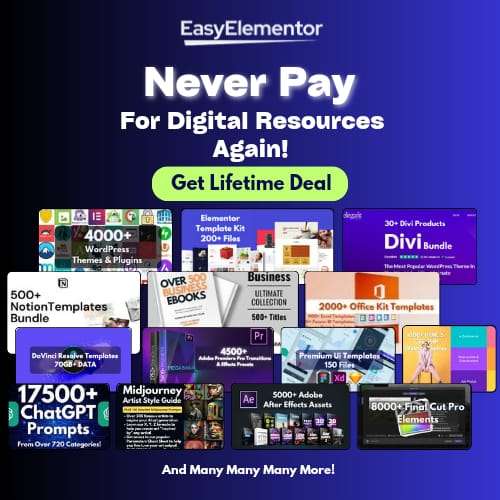
Platinum Plan | Lifetime Access
Never Pay For PLR Digital Products Again Everything is Already Done For You!
Get unlimited access to exclusive PLR digital products, tools, and resell-ready assets. All In One Place
Great PLR digital products collection for Beginners, Entrepreneurs, Professionals, Resellers
- Weekly New Bundles
- Reselling Rights
- Lifetime Updates
Curating and Bundling Strategy
Even without creation skills, you can build value through curation. Bundle complementary products together addressing complete workflows rather than isolated tasks.
For example, combine a website theme, matching Elementor templates, essential plugins, and a setup guide into a “Complete Website Starter Kit”. Price the bundle higher than individual components while still offering clear value.
Add unique bonuses that differentiate your bundle from others using similar PLR sources. Create video walkthroughs, write better documentation, or provide email support—these additions justify higher prices and build your brand.
From Real Experience: I was skeptical about PLR until I saw a colleague generate $6,000 in three months using this exact strategy. She accessed a PLR library, selected high-quality Elementor templates, organized them by industry (real estate, restaurants, fitness, etc.), added detailed video tutorials showing installation and customization, and sold these as “Industry-Specific Website Kits” for $47-$97 each.
Her secret sauce wasn’t the templates themselves—those were available to other PLR license holders too. Her differentiation came from the packaging and support. She created a professional sales page explaining exactly what buyers would receive, why these templates suited their industry, and how to customize them without coding knowledge. She included video walkthroughs for each template, a PDF quick-start guide, and 30-day email support.
This transformed commodity PLR products into premium solutions. The Reddit community r/Entrepreneur has numerous discussions about PLR done right versus wrong. The wrong approach: buying cheap PLR, making zero modifications, slapping your name on it, and hoping for sales. That fails every time because dozens of others are doing the same thing.
The right approach: treating PLR as raw material that you refine, customize, and package uniquely. One user mentioned buying PLR eBooks, completely rewriting 40-50% of the content to add current examples and their personal experience, redesigning all graphics, and then selling successfully because the end product was genuinely different and better. The lesson? PLR is a starting point, not a finished product.
If you use EasyElementor’s resources or similar PLR libraries, invest time in customization. Change colors to match your brand, rewrite descriptions, create better previews, bundle strategically, and most importantly—test everything to ensure quality before selling.
Get : Done For You Digital Products
Marketing Strategy
Creating great products means nothing if nobody knows they exist. Your marketing strategy determines whether you make $100 or $10,000 monthly.
Content Marketing Foundation
Content marketing remains the most effective free strategy for digital product sellers. You create valuable content that attracts your target audience, demonstrate expertise, and naturally transition people to your paid products.
Blogging builds long-term organic traffic through search engines. Write detailed articles answering questions your target customers ask, naturally linking to your products as solutions. This approach generated over 60% of my digital product sales without paid ads.
YouTube provides enormous reach for visual learners. Tutorial videos, product demos, and educational content build authority while driving product sales through video descriptions and pinned comments.
Podcasting connects with audiences during commutes and workouts. Interview experts in your niche, discuss industry trends, and mention your products as resources for listeners wanting to dive deeper.
Platform-Specific Strategies
| Platform | Content Type | Posting Frequency | Conversion Strategy |
|---|---|---|---|
| Graphics, infographics, product previews | 5-10 pins daily | Link directly to product pages | |
| Carousel posts, Reels, Stories | 1 post + 2 stories daily | Link in bio, Story links (10K+ followers) | |
| TikTok | Short tutorials, tips, behind-scenes | 1-3 videos daily | Link in bio, mention products in videos |
| Twitter/X | Tips, threads, product updates | 3-5 tweets daily | Profile link, thread CTAs |
| Professional insights, case studies | 2-3 posts weekly | Document posts with product links | |
| Value-first answers, discussions | 2-3 quality comments daily | Mention products when genuinely helpful |
Email Marketing That Works
Email consistently delivers the highest ROI for digital product businesses. Build your list by offering free lead magnets—simplified versions of your paid products or complementary resources.
Your welcome sequence should deliver the promised freebie, provide additional value, share your story, and introduce your paid products. Spread this over 5-7 emails across 10-14 days rather than bombarding immediately.
Regular newsletters maintain relationships with subscribers. Share valuable tips, industry news, behind-the-scenes updates, and periodic product promotions. A 80/20 ratio (80% value, 20% promotion) keeps engagement high while generating consistent sales.
The Power of Free Products
Strategic freebies build massive email lists quickly. Create genuinely useful free versions of your products—not watered-down junk, but actually valuable tools that solve specific problems.
The psychology works beautifully: when you deliver unexpected value for free, recipients feel compelled to reciprocate by checking out your paid offerings. I’ve consistently seen 8-12% of freebie downloaders purchase paid products within 30 days.
Free products also generate word-of-mouth marketing. When something is both free and genuinely useful, people share it with friends and colleagues, exponentially expanding your reach without advertising costs.
From Real Experience: My marketing journey has been a masterclass in what NOT to do, followed eventually by what actually works. Initially, I believed “build it and they will come.” Spoiler alert: they absolutely will not come. I launched products, shared them once on Twitter and LinkedIn, then wondered why sales were crickets. The breakthrough came when I committed to content marketing.
I started writing blog posts answering specific questions my target audience asked. Not surface-level fluff, but detailed, actionable posts that actually solved problems. For each post, I’d include my digital product as the logical next step for readers wanting a shortcut. For example, I wrote a 2,500-word guide on “How to Conduct Competitive Analysis for SEO.” At the end, I mentioned my competitive analysis template as a time-saving tool for $12.
That single blog post generated $840 in template sales over six months. The key was search intent alignment—people searching for competitive analysis help were perfect candidates for a ready-made template. I replicated this across 15 similar topics, creating a content flywheel that generates passive sales. Reddit taught me another crucial lesson: provide value first, pitch second. I started genuinely answering questions in r/SEO, r/Entrepreneur, and niche-specific subreddits.
When my answer was comprehensive, I’d add at the end, “I actually created a template for this if you want to save time implementing it,” with a link. The conversion rate from Reddit traffic is lower than from my blog (around 2-3% vs. 8-10%), but the volume compensates. One detailed Reddit comment with 200 upvotes sent 400+ people to my product page, resulting in 9 sales. For email marketing,
I finally got serious about it last year. I created a free “SEO Checklist” as my lead magnet and promoted it through blog posts, social media, and a simple pop-up on my website. That checklist has generated 2,100+ email subscribers. My welcome sequence delivers the checklist, follows up with additional tips, shares my story (building connection), then introduces my paid products as natural next steps. This automated sequence generates 15-20 sales monthly without any additional effort.
Scaling Strategy
Scaling your digital product business requires deliberate strategy beyond just creating more products.
Product Ladder Development
Your product ladder guides customers from free to premium offerings. Structure it strategically to maximize customer lifetime value.
The typical ladder includes a free lead magnet (entry point), a low-priced product ($7-$27) that requires minimal decision-making, a mid-tier product ($47-$147) solving more complex problems, and a premium offering ($297-$997) providing comprehensive solutions or personal access.
Each tier should naturally lead to the next. Your $17 template might include a bonus guide mentioning your $97 course for those wanting deeper implementation help.
Automation and Systems
Automation transforms your business from active income to passive income. Set up systems that handle customer interactions, product delivery, and marketing without constant involvement.
Email automation handles welcome sequences, product onboarding, and promotional campaigns. Tools like ConvertKit, ActiveCampaign, or Omnisend manage these workflows effortlessly.
Product delivery automation ensures customers receive purchases instantly. All major platforms (Gumroad, Payhip, Shopify with Digital Downloads app) handle this automatically, creating seamless customer experiences.
Customer service automation uses FAQ pages, knowledge bases, and chatbots to handle common questions. This frees your time for high-value activities while maintaining customer satisfaction.
Strategic Partnerships
Affiliate programs multiply your sales force. Offer 20-40% commissions to influencers, bloggers, and complementary business owners who promote your products to their audiences.
Collaboration bundles combine your products with others’ for limited-time offers. These generate excitement, reach new audiences, and often produce massive sales spikes (like the $34,000 three-day bundle launch mentioned in one entrepreneur’s case study).
Guest content on established platforms exposes you to larger audiences. Write guest blog posts, appear on podcasts, or create YouTube collaborations where you provide value while naturally mentioning your products.
Timeline for Growing Your Digital Product Business
| Phase | Timeline | Activities | Expected Outcomes |
|---|---|---|---|
| Foundation | Weeks 1-4 | Research niche, validate idea, create first product, set up selling platform | Product live, first 1-3 sales |
| Initial Traction | Months 2-3 | Content marketing, build email list, create 2-3 more products, gather feedback | 10-30 sales monthly, 100-300 email subscribers |
| Momentum Building | Months 4-6 | Consistent content, expand product line, optimize pricing, start email marketing | 50-100 sales monthly, 500-1,000 subscribers |
| Growth Phase | Months 7-12 | Launch affiliate program, create product bundles, scale content production | 150-300 sales monthly, $2,000-$5,000 revenue |
| Scaling Phase | Year 2+ | Add premium products, build membership/subscription, explore new platforms | 500+ sales monthly, $10,000+ revenue |
Diversification Strategy
Platform diversification protects against algorithm changes and policy updates. Sell on multiple platforms to spread risk—if Etsy changes their algorithm or Gumroad increases fees, your entire business doesn’t collapse.
Product diversification appeals to different customer segments and price points. Some people want quick templates; others want comprehensive courses. Serve both.
Revenue stream diversification includes product sales, affiliate commissions from tools you recommend, sponsored content, and potentially coaching or consulting for your premium customers.
From Real Experience: Scaling felt impossible until I understood leverage. I was stuck in the “create and launch” cycle—finish a product, launch it, make some sales, then immediately start creating the next one. This kept me perpetually busy but not growing. The shift happened when I focused on systems. First, I built my product ladder. I had my $12-$27 templates (entry products), so I created a $97 “Complete Toolkit Bundle” combining my five best templates with bonuses.
Then I developed a $297 course teaching people how to use these tools strategically for business growth. Suddenly, some customers were buying $12 products, others were jumping to the $97 bundle, and a few invested in the $297 course. This tripled my average customer value. The game-changer was launching an affiliate program. I offered 30% commissions to anyone promoting my products.
Within two months, I had 15 active affiliates—bloggers and YouTubers in my niche. They created content mentioning my products, and suddenly I was getting sales from audiences I never could have reached alone. One affiliate’s YouTube video generated 47 sales of my $97 bundle in a single month. My cut was $3,290 after their commission—not bad for something requiring zero work from me beyond creating the product once.
The timeline chart above reflects my actual growth, though I made plenty of mistakes that slowed progress. In reality, I didn’t hit $2,000 monthly until month 10 because I wasted time perfecting products instead of marketing them. I didn’t launch my affiliate program until month 14, which delayed scaling significantly. If I started over today with what I know, I’d compress that timeline by 3-4 months by avoiding perfectionism and implementing affiliate marketing much earlier.
A Reddit user shared their timeline going from $0 to $10K in 18 months selling digital products. Their key moves: launched fast with imperfect products, created one piece of content daily (blog, video, or social post), built an email list from day one, and started affiliate partnerships at month 6. They emphasized that months 1-5 felt like shouting into the void, but months 6-12 showed exponential growth as their content library compounded and affiliates kicked in.
Get : Done For You Digital Products
Mistakes To Avoid
Learning from others’ mistakes saves you months of frustration and lost revenue.
Product Creation Mistakes
Making your first product too complex is the most common beginner error. You don’t need a 50-video course or 200-page eBook. Start with something you can finish and launch within 1-2 weeks maximum.
Building without validation wastes enormous time and energy. Validate demand before investing serious creation time by testing interest through social posts, surveys, or pre-selling the concept.
Perfectionism paralysis stops more digital product businesses than any other factor. Done and improving beats perfect and unreleased every single time. Launch at 80% completion, gather feedback, and refine based on actual customer needs.
Ignoring customer feedback once you do launch misses golden improvement opportunities. Actively request reviews, conduct customer surveys, and implement suggested improvements in updated versions.
Pricing Mistakes
Pricing too low destroys perceived value and attracts problem customers. People often judge quality by price, so your $5 product might seem less valuable than a competitor’s $27 product even if yours is better.
Pricing too high without proven value scares away early customers when you have no testimonials or social proof. Start at moderate pricing, gather reviews and testimonials, then gradually increase prices.
Using one-size-fits-all pricing ignores different customer segments. Some buyers want the basics; others want premium packages. Tiered pricing lets you serve both groups effectively.
Never adjusting prices leaves money on the table. Test price increases periodically—you might be surprised that a 30% price increase only reduces sales by 10%, dramatically improving profitability.
Marketing Mistakes
Relying solely on paid ads without building organic channels creates unsustainable costs. Paid ads work but should complement organic strategies (content marketing, SEO, social media), not replace them.
Ignoring free promotional opportunities wastes readily available exposure. Platforms like Reddit, Quora, niche forums, and Facebook groups provide free access to targeted audiences if you provide value first.
Selling directly without relationship building dramatically reduces conversion rates. People buy from those they know, like, and trust. Build relationships through valuable content before asking for sales.
Spreading too thin across all platforms dilutes your efforts. Master one platform first, build a system, then expand to a second. Trying to be everywhere simultaneously ensures mediocrity everywhere.
Business Management Mistakes
Lacking clear systems and organization creates chaos as you scale. Document your processes, organize files logically, and create repeatable workflows from the beginning.
Neglecting email list building throws away your most valuable asset. Your email list is the only audience you truly own—social platforms can disappear or change algorithms overnight.
Not tracking metrics and analytics leaves you flying blind. Monitor which traffic sources convert best, which products sell most, which email sequences perform strongest, and optimize accordingly.
Failing to plan for taxes and legal considerations creates headaches later. Set aside 25-30% of revenue for taxes, understand digital product tax rules in your region, and consider creating an LLC or formal business entity.
From Real Experience: Oh boy, where do I even start with my mistakes? I’ve made virtually every error on this list, some multiple times because apparently I’m a slow learner. My biggest mistake was building a comprehensive course without validating demand.
I spent four months creating a 30-video course on content marketing strategy. The topic? Something I assumed people wanted because it sounded impressive. I launched it at $197, announced it to my small email list, posted on social media, and… sold 3 copies. Three. Total revenue: $591. I calculated that I’d invested approximately 120 hours creating this course, which meant I earned $4.93 per hour. McDonald’s pays better.
The painful lesson: I built what I wanted to create, not what my audience wanted to buy. Had I simply asked my audience or tested interest with a waitlist, I would have discovered that they wanted quick-reference tools, not another lengthy course. They were already drowning in courses and information; they needed implementation shortcuts. My pricing mistakes were equally embarrassing.
I initially priced my templates at $5 because I thought, “They only took me 2 hours to make, so they can’t be worth much.” Wrong. They were worth whatever time and frustration they saved the buyer, not whatever time I spent creating them. A template that saves someone 4 hours of work is easily worth $20-$30. When I finally raised prices to $17-$27, my sales volume barely changed, but my revenue nearly tripled.
The Reddit community taught me about the direct-selling mistake. I used to share my products everywhere with “Check out my new template!” posts. Engagement was terrible. Then I shifted to value-first sharing. I’d write a detailed answer to someone’s question on Reddit, solve their problem completely in my comment, then add at the end, “I actually created a template for this if you want to save time implementing it.” My conversion rate jumped from under 1% to around 3% just by building trust before asking for sales. One more painful mistake: ignoring my email list.
I collected 400 email subscribers through my freebie but then never emailed them because I didn’t want to be “annoying.” Three months passed before I sent anything. By then, half the list had forgotten who I was, and I got 20+ unsubscribes on my first email. Had I nurtured that list with regular valuable content, those 400 subscribers could have generated thousands in sales. Instead, my negligence turned a valuable asset into a nearly useless list of strangers.
Small Launching Plan
A structured launch plan maximizes your product’s debut impact. Here’s a proven 30-day framework.
Pre-Launch Phase (Days 1-21)
Week 1: Create buzz and anticipation
- Announce you’re working on something exciting (without full details)
- Poll your audience about features or elements they’d want included
- Share behind-the-scenes content showing your creation process
- Start building a waitlist for early access or launch discounts
Week 2: Build anticipation and provide value
- Release 2-3 pieces of content related to your product’s topic
- Share testimonials from beta testers (if applicable)
- Create a countdown campaign on social media
- Send email updates to your waitlist with preview content
Week 3: Prepare final details
- Finalize product materials, sales page, and checkout process
- Create all marketing materials (graphics, videos, email sequences)
- Set up affiliate links if using partner promotions
- Prepare customer onboarding sequence
Launch Week (Days 22-28)
Day 22 (Launch Day):
- Send announcement email to your full list
- Post across all social platforms with compelling visuals
- Publish a blog post explaining the product and its benefits
- Reach out to affiliates and partners to begin promotion
Days 23-25 (Momentum Phase):
- Share customer testimonials and early results
- Create urgency with limited-time launch pricing or bonuses
- Go live on Instagram/Facebook/YouTube to answer questions
- Engage with all comments and messages personally
Days 26-28 (Final Push):
- Send “last chance” emails to your list
- Share final testimonials and results from early buyers
- Remove launch bonuses or return to regular pricing
- Thank everyone who supported the launch
Post-Launch Phase (Days 29-30)
- Send thank-you emails to buyers with onboarding instructions
- Request feedback and testimonials from customers
- Analyze launch metrics (sales, traffic sources, conversion rates)
- Plan improvements based on feedback for Version 2.0
From Real Experience: My first organized launch followed this framework, and it was night-and-day different from my previous “just post it and hope” approaches. I was launching a social media content calendar template bundle. Three weeks before launch, I started teasing it on Twitter and Instagram—showing screenshots of the templates, asking my audience what platforms they needed calendars for, running polls about features.
This engagement was gold because it made people feel invested in the product before it even existed. I built a waitlist of 112 people using a simple Google Form offering 30% off launch pricing for early subscribers. On launch day, I emailed that waitlist first, giving them 24 hours of exclusive early access. That alone generated 18 sales before I even announced publicly. The scarcity and exclusivity made people act fast.
Then I published a blog post titled “Why I Created This Content Calendar (And How It’ll Save You 5 Hours Weekly),” which provided context and value while selling the product. I posted across all platforms, went live on Instagram for 20 minutes answering questions about the templates, and sent a launch announcement to my full email list of 680 people. Days 2-4 of the launch, I shared customer testimonials as they came in. Social proof is powerful—each testimonial generated 2-3 more sales from people on the fence.
I also created urgency by announcing that launch pricing ($27 instead of the regular $37) would end in 5 days. This pushed indecisive buyers to act. The final push came with “last chance” emails and social posts on day 6. This generated a small surge of last-minute buyers who hate missing out on deals. Total results: 67 sales at $27 each = $1,809 revenue in one week. Compared to my usual “just post it” launches that generated maybe 5-8 sales over a month, this structured approach was transformative.
The key lessons: build anticipation before launch, create urgency and scarcity, leverage social proof, and maintain momentum throughout the launch week rather than just announcing once and disappearing.
Online Tools for Digital Product Business
The right tools streamline creation, marketing, and selling. Here’s your comprehensive toolkit organized by function.
Product Creation Tools
| Category | Tool Name | Best For | Pricing | Key Features |
|---|---|---|---|---|
| Design | Canva | Graphics, templates, eBooks | Free-$14.99/mo | 250K+ templates, drag-and-drop, brand kit |
| Design | Adobe Creative Cloud | Professional design work | $54.99/mo | Photoshop, Illustrator, InDesign, Premiere |
| Writing | Google Docs | eBooks, guides, documents | Free | Collaboration, cloud storage, templates |
| Spreadsheets | Google Sheets | Budget trackers, planners | Free | Formulas, templates, sharing |
| Video | Descript | Video courses, tutorials | Free-$24/mo | AI editing, transcription, screen recording |
| Presentations | Gamma | Course materials, presentations | Free tier | AI-powered, no design skills needed |
| Web Development | WordPress + Elementor | Websites, membership sites | Free-paid themes | Drag-and-drop, highly customizable |
Selling Platforms
| Platform | Best For | Setup Time | Monthly Cost | Transaction Fees |
|---|---|---|---|---|
| Gumroad | Quick starts | 15 minutes | $0 | 10% + payment processing |
| Payhip | EU/UK sellers | 20 minutes | $0 | 5% (free) or $29/mo (0%) |
| Shopify | Full stores | 2-4 hours | $39+ | Payment processing only |
| Podia | Courses & memberships | 1-2 hours | $0-$89 | 8% (free) or 0% (paid plans) |
| Sellfy | All-in-one | 1 hour | $19-$199 | 0% |
Marketing Tools
| Function | Tool Name | Purpose | Pricing | Integration |
|---|---|---|---|---|
| Email Marketing | ConvertKit | Email sequences, list management | $0-$29+/mo | All platforms |
| Email Marketing | Omnisend | Email + SMS automation | Free-$16+/mo | Shopify, others |
| Social Scheduling | Buffer | Social media planning | Free-$6/mo | All platforms |
| Analytics | Google Analytics | Traffic tracking | Free | All websites |
| SEO | Google Search Console | Search performance | Free | All websites |
| Chatbots | ManyChat | Customer engagement automation | Free-$15+/mo | Social platforms |
Customer Service Tools
| Tool | Function | Best Use | Cost |
|---|---|---|---|
| Tidio | Live chat widget | Real-time support | Free-$15.83/mo |
| Zendesk | Ticket system | Professional support | $19-$99/user/mo |
| Notion | Knowledge base | FAQs, documentation | Free-$8/user/mo |
| Loom | Video messages | Tutorial responses | Free-$8/mo |
Beginner-Friendly Tool Stack (Free/$0-50/month)
For someone just starting with minimal budget:
- Creation: Canva (free tier) + Google Workspace (free)
- Selling: Gumroad (pay per sale) or Payhip (free plan)
- Marketing: Buffer (free tier) + ConvertKit (free up to 1,000 subscribers)
- Analytics: Google Analytics (free)
- Total monthly cost: $0-$15
Growing Business Stack ($50-200/month)
For businesses making $1,000-$5,000 monthly:
- Creation: Canva Pro ($14.99/mo) + Adobe Creative Cloud ($54.99/mo)
- Selling: Shopify ($39/mo) + Digital Downloads app
- Marketing: ConvertKit ($29/mo) + Buffer ($6/mo)
- Customer Service: Tidio ($15.83/mo)
- Total monthly cost: $159.81
Professional Stack ($200-500/month)
For businesses making $10,000+ monthly:
- Creation: Adobe Creative Cloud ($54.99/mo) + Advanced tools
- Selling: Shopify Advanced ($399/mo) or Podia Pro ($89/mo)
- Marketing: ActiveCampaign ($187/mo) + Social tools
- Customer Service: Zendesk ($55/mo)
- Analytics: Advanced tracking tools
- Total monthly cost: $400+
From Real Experience: I wasted probably $2,000 in my first year subscribing to tools I barely used because everyone said they were “essential.” Turns out, you don’t need fancy tools to start—you need action. My actual first sale came from a template I designed in Canva’s free version, sold through Gumroad’s free plan, and promoted via a simple tweet. Zero dollars in tools.
But as I scaled, strategic tool investments paid off. Moving from Gumroad’s pay-per-sale model to Shopify at $39/month seemed scary, but once I hit $2,000 monthly sales, the math favored Shopify. The bigger game-changer was email marketing. I resisted paying for ConvertKit ($29/mo) for months, manually sending emails through my Gmail like an amateur. When I finally switched, the automated welcome sequences and sales funnels generated an additional $400-600 monthly without extra work—a 15-20x return on the $29 investment.
The tool decision framework I use now: Will this tool either (1) save me 3+ hours monthly, or (2) generate at least 3x its cost in additional revenue? If neither, I don’t buy it. Most creators tools too early and create too little. They have every app, plugin, and platform subscription but haven’t launched a single product. Flip that equation. Launch products with free tools, then upgrade strategically as revenue justifies it.
One Reddit user perfectly captured this: “I made my first $5K with free tools. Then I invested $200/month in upgrades and scaled to $15K monthly. The tools didn’t create success—they amplified existing success”. Also, don’t underestimate tool integrations. I use Zapier ($20/mo) to connect my tools: when someone buys on Gumroad, Zapier adds them to my ConvertKit email sequence and logs the sale in a Google Sheet for tracking. This automation saved me hours weekly of manual data entry.
Get : Ready Made Digital Products
What Best Websites Lack & How to Fill the Gap
Most digital product websites make critical mistakes that you can exploit as competitive advantages.
Poor Product Documentation
The Gap: Many sellers provide digital products with minimal instructions or documentation. Customers receive files with no guidance on implementation or customization.
Your Opportunity: Create comprehensive onboarding materials. Include PDF guides, video walkthroughs, and even Loom screencast recordings showing exactly how to use your products. This dramatically reduces refund requests and generates glowing testimonials.
Implementation: For each product, create a 2-3 page quick-start guide, a 5-10 minute video walkthrough, and a FAQ document addressing common questions. Host these in a simple Notion workspace customers can access after purchase.
Lack of Niche Specificity
The Gap: Most digital products are generic—calendar templates “for everyone,” business plans “for all industries,” social media templates “for any business”.
Your Opportunity: Create hyper-targeted niche products. A social media calendar specifically for real estate agents will outperform a generic one because real estate agents immediately see relevant content and examples.
Implementation: Choose 2-3 specific niches you understand well. Adapt your digital products specifically for those niches with relevant examples, terminology, and industry-specific elements. Price these niche products 30-50% higher than generic alternatives because specificity is valuable.
Poor Customer Support
The Gap: Digital product sellers often disappear after the sale, leaving customers frustrated with technical issues or questions.
Your Opportunity: Provide exceptional post-purchase support. Answer questions within 24 hours, create a customer-only community, and actively improve products based on feedback.
Implementation: Set up a simple email support system (support@yourdomain.com), commit to 24-hour response times, and create a customer-only Facebook group or Discord server where buyers can ask questions and share wins.
Weak Social Proof
The Gap: Many digital product pages lack testimonials, reviews, or proof that the product works.
Your Opportunity: Aggressively collect and display social proof. Request testimonials from every satisfied customer, display purchase counts, share customer success stories, and showcase real examples of your products in use.
Implementation: Add a testimonial request to your product thank-you email, offer small bonuses (additional template, discount code) in exchange for reviews, and create a “Customer Wins” section on your sales page featuring real results.
Why EasyElementor Fills These Gaps
EasyElementor addresses several common digital product business challenges directly:
1. The “I don’t know what to create” problem: With access to 1 million+ ready-made digital products, you eliminate creation paralysis. Browse proven products that already sell, customize them, and focus your energy on marketing rather than creation.
2. The quality consistency problem: Creating high-quality WordPress themes and Elementor templates from scratch requires significant technical skills. EasyElementor provides professionally designed templates you can confidently sell.
3. The product variety problem: Building a comprehensive product catalog takes years if you create everything yourself. EasyElementor instantly gives you inventory across multiple categories—themes, templates, plugins, complete website kits—letting you serve different customer needs immediately.
4. The speed-to-market problem: Traditional product creation takes weeks or months. With EasyElementor, you can have a sellable, branded product ready in hours: pick a template, add your branding, create your sales page, and launch.
5. The resale rights challenge: Most digital products don’t include resale rights, limiting your business model options. EasyElementor explicitly provides full resale rights, allowing you to legally sell these products as your own.
From Real Experience: I analyzed 30 competitor websites in my niche while developing my positioning strategy. Here’s what I found 90% of them lacked:
Specific use cases and examples: Their product pages said “social media template” with generic screenshots. I created product pages showing exactly what you get: “12 Instagram posts for fitness coaches, including 3 motivational quote templates, 4 workout tip templates, 3 before-after showcase templates, and 2 client testimonial templates.” This specificity immediately resonated with fitness coaches who saw themselves in the product.
Actual customer results: Everyone claimed their products were “amazing” and “high-quality,” but almost nobody showed customer results. I started featuring testimonials like “This template saved me 6 hours per week on content creation” with the customer’s name, photo, and business. That specificity and proof crushed generic “great product!” testimonials.
Implementation support: Most sellers delivered products and disappeared. I added 30-day email support and a customer Facebook group. This generated incredible word-of-mouth because customers told friends, “Not only is the product great, but the creator actually helps if you have questions!” That community became a goldmine of product improvement ideas and testimonials.
For those using PLR or platforms like EasyElementor, the customization and support differentiation is even more critical. Since others might access similar PLR libraries, your competitive advantages become: (1) better packaging and positioning, (2) niche-specific customization, (3) superior documentation and tutorials, (4) actual customer support, and (5) building a brand that people trust.
Someone buying a WordPress theme from EasyElementor’s library and someone buying YOUR version of that theme should have dramatically different experiences. Your version should include video setup tutorials, industry-specific examples, detailed documentation, and support. That justifies higher pricing and builds customer loyalty that PLR alone never could.
Get : Done For You Digital Products
Frequently Asked Questions
1. How much money do I need to start a digital product business?
You can start with $0 to $50. Free tools like Canva, Google Docs, and Gumroad handle creation and selling without upfront costs. The only potential expense is a domain name ($10-15/year) if you want a branded presence, though even that’s optional initially.
Learn more about: Is Faceless Content Still Worth it?
2. How long does it take to make your first sale?
Typically 2-4 weeks for beginners who actively market their products. Some creators make sales within 48 hours if they have existing audiences or use paid advertising. The key is validation before creation and immediate marketing after launch.
3. Do I need to be an expert to create digital products?
No—you just need to know more than your target beginner audience. If you’re intermediate-level at something, you can create products for beginners. Focus on solving specific problems you’ve personally overcome.
4. What digital products sell best for beginners?
Templates, checklists, spreadsheets, and swipe files sell consistently well for beginners. They’re quick to create, have clear value propositions, solve immediate problems, and require lower price points that reduce buyer hesitation.
5. Can I really make money with PLR products?
Yes, if you customize them significantly. Simply reselling unchanged PLR products rarely succeeds because competitors do the same thing. Add your voice, update content, improve design, create better documentation, and build your brand around the products.
6. How do I price my digital products?
Start with value-based pricing: What’s it worth to your customer, not what it cost you to create. Test different price points and track conversion rates. A good starting range is $7-27 for templates, $47-97 for bundles, and $97-297 for courses.
7. Should I use marketplaces like Etsy or self-hosted platforms?
Start with both if possible. Marketplaces provide built-in traffic but higher fees and less control. Self-hosted platforms offer better margins and branding but require you to drive traffic. Using both diversifies risk and revenue sources.
8. How important is building an email list?
Critically important—it’s your only truly owned audience. Social platforms can disappear or change algorithms overnight, but your email list stays with you. Aim to collect emails from day one using free lead magnets.
9. What’s the best way to promote digital products without paid ads?
Content marketing through blogging, YouTube, or podcasting generates the highest long-term ROI. Additionally, engage genuinely in niche communities (Reddit, Facebook groups, forums) by providing value before mentioning products.
10. How many products should I create before launching?
Start with just ONE product. Launch it, gather feedback, make initial sales, and validate your process. Many beginners create 5-10 products before launching anything, which delays learning and revenue. Launch fast, then expand your catalog based on customer requests.
11. What legal stuff do I need to handle?
Basics include setting aside 25-30% of revenue for taxes, understanding digital tax laws in your region (especially EU VAT), creating basic terms of service and privacy policies, and potentially forming an LLC for liability protection. Start simple and consult professionals as you scale.
12. How do I handle refunds and customer complaints?
Offer a 14-30 day money-back guarantee to reduce buyer hesitation. Honor refund requests promptly without argument—difficult customers aren’t worth the stress. Most digital product businesses see 2-5% refund rates if products deliver on promises.
13. Can I sell digital products as a side hustle?
Absolutely—most successful creators started as side hustles. Digital products work well alongside full-time jobs because you can create on weekends and automate sales and delivery. Allocate 5-10 hours weekly and you can build substantial income over 6-12 months.
14. What’s the biggest mistake beginners make?
Creating products without validating demand first. Beginners spend months perfecting products nobody wants instead of testing ideas quickly, gathering feedback, and iterating. Always validate before investing significant creation time.
15. How do I stand out in saturated markets?
Niche down and add personal elements. Instead of “social media templates,” create “social media templates for vegan restaurant owners” with industry-specific examples. Add video tutorials, personalized support, or community access that generic competitors don’t offer.
16. Should I create free products or only paid ones?
Both strategically. Free lead magnets build your email list and demonstrate value, but relying solely on free products leads to burnout. Use a balanced approach: free products that attract and qualify leads, paid products that generate revenue.
17. How long does it take to reach $10,000 monthly?
Typically 12-24 months for creators consistently creating content, building audiences, and expanding product catalogs. Some reach it faster with existing audiences, exceptional marketing skills, or viral products. Focus on systems and consistency rather than overnight success.
18. Do I need perfect design skills?
No—tools like Canva make professional-looking products accessible to anyone. Focus on clarity and functionality over artistic perfection. A simple but useful product outsells a beautiful but confusing one every time.
19. Can I sell digital products internationally?
Yes—digital products are inherently global. All major platforms handle international payments and currency conversion automatically. Be aware of tax obligations, particularly EU VAT rules if selling to European customers.
20. What should I do if my product isn’t selling?
Diagnose the problem systematically: Is traffic low (marketing issue)? Is traffic high but conversions low (product-market fit or sales page issue)? Are refunds high (product quality issue)? Gather feedback from your target audience, test price changes, improve your sales copy, or pivot to a different product addressing a clearer pain point.
Final Thoughts: Your Digital Product Journey Starts Today
Starting a digital product business in 2026 offers unprecedented opportunities for creators at all skill levels. The barriers have never been lower—free tools handle creation, pay-as-you-go platforms manage selling, and content marketing drives traffic without advertising budgets.
Your first step isn’t creating the perfect product. It’s validating an idea your audience actually wants. Spend this week researching what problems your target customers face, what questions they repeatedly ask, and what solutions they currently use but complain about.
Then create something small and useful—a template, checklist, or guide—that addresses one specific problem. Launch it within 2 weeks, even if it feels imperfect. Your first product teaches you more about the business than months of research ever could.
The digital product creators making $5,000, $10,000, or $50,000 monthly all started exactly where you are right now. The difference? They launched, learned, and iterated instead of waiting for perfect conditions that never arrive.
Your digital product business won’t build itself. But with the strategies, tools, and frameworks in this guide, you have everything you need to start today and scale systematically.
The question isn’t whether you can do this. The question is: Will you start today, or will you still be thinking about it a year from now?
https://www.shopify.com/blog/digital-products
https://sellfy.com/blog/digital-products/
https://zanfia.com/blog/best-platform-to-sell-digital-products/
https://www.easy.tools/blog/platforms-to-sell-digital-products
https://www.youtube.com/watch?v=Ye0de7nkWYg
https://wedevs.com/blog/489429/digital-products-to-sell/
https://www.wpbeginner.com/showcase/tools-for-creating-and-selling-digital-products/
https://www.reddit.com/r/digisellers/comments/1lz86y9/common_mistakes_in_digital_product_selling/
https://www.indigitalworks.com
https://www.plrdigitalplanner.com
https://www.reddit.com/r/Entrepreneur/comments/r435f3/ive_experimented_with_digital_products_for_a/
https://www.youtube.com/watch?v=tRNImli_nKc
https://www.youtube.com/watch?v=OH696SJA4aA
https://www.simform.com/blog/digital-product-lifecycle/
https://www.esparkinfo.com/blog/digital-product-lifecycle
https://www.reddit.com/r/Entrepreneur/comments/1jglxtn/what_digital_sales_mistakes_are_you_making/
https://www.youtube.com/watch?v=XilHrzfc3Jk
https://www.youtube.com/watch?v=5JUMlFyFfzE